
Hummingbird Scientific engineers complete in-situ microscopy systems, not just specimen holders.
Hummingbird Scientific designs, machines, assembles, calibrates, and validates advanced in-situ microscopy instruments in-house. Our engineering team works across precision mechanics, vacuum systems, microfluidics, MEMS chips, electronics, software, calibration, and TEM applications to build tools that help researchers control experiments at the nanoscale.
Hummingbird is not only a specimen holder company. We build the engineering stack behind advanced in-situ microscopy: design, machining, microfabrication, assembly, inspection, calibration, electronics, software, applications support, and microscope validation.
Design

Machine
Assemble
Calibrate
Test
Improve

Design
Turn scientific requirements into instrument concepts, from first-principles analysis through 3D CAD and FEA.

Machine
Build precision parts where tolerance and surface finish directly affect what researchers can measure.

Assemble
Bring mechanical, electrical, fluidic, and thermal systems together into one instrument.

Calibrate
Verify sensors, motion, temperature response, and electrical stability against real application requirements.

Test
Validate instruments under real microscopy conditions in our in-house TEM and cryo-EM labs.

Improve
Learn from the lab, the shop floor, and researchers in the field, then make the next version better.
Bridging the nanoscale to the macroscale
What are the challenges of microscopy hardware engineering?
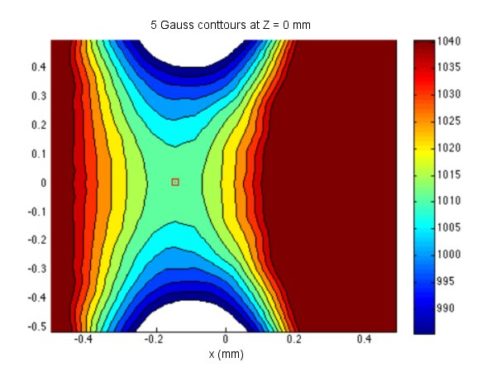
One of the most demanding operating environments in engineering
Specimen holders must function reliably in high-vacuum while maintaining exceptional mechanical stability, thermal and chemical compatibility, and electrical isolation. In-situ experiments bring a new set of challenges, requiring holder designs that control for all variables except for the isolated stimuli while maintaining precise alignment and minimizing artifacts from a damaging high-energy electron probe.
Engineering across multiple length scales
Nanoscale characterization and analysis experiments demand precision across orders of magnitude. Nanometer-scale positioning, temperature fluctuations, electrical signals, and fluid flows must be controlled and measured with extraordinary accuracy. At the nanoscale, seemingly insignificant mechanical tolerances can dramatically impede experiments. A micron-scale misalignment or burr will translate into substantial image shifts, loss of resolution, poor user experience, and reduced reproducibility.
Software, electronics, and integration
Hummingbird's approach to holder control and TEM software

Integrated, intuitive, and accessible software packages
Software should be an accessible platform, not an island with a moat. Our standalone software modules control holder functionality, simplifying workflows and improving user experience, all without subscriptions or limits on license duration or number of installations. Ask us about custom control software modules and routines.
Flexible and interoperable software platforms
Our software is modulary compatibile with OEM software ecosystems, allowing for seamless platform integration and data management pipelines. We view growing support for open Python APIs amongst OEMs and specialized tool manufacturers as a positive trend that will bolster efforts to implement synchronization, automation, and AI-driven workflows.
Multiscale electronics design
Why is our holistic approach to electronics design essential?
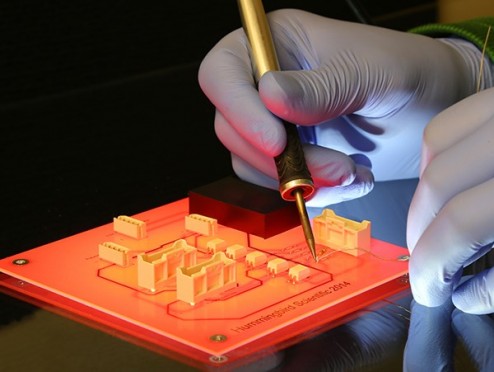
Bespoke integration of multiscale electronics
Because our applications require specialized sample environments and stimulus controls, an array of multiscale components must be inegrated, including connectors, multi-layer circuit boards, microfabricated chips, cabling, and software. Our expertise with these bespoke electronic ensembles allows us to consider custom electronic holder configurational options.
In-house microfabrication
We are the only sample holder maker with dedicated division for substrate microfabrication. Our in-house developed and fabricated lab-on-a-chip microelectronic configurations can heat and bias samples concurrently, in a high-vacuum or environmental cell environment. This means we can design and fabricate custom chips with novel electrode geometries and materials. Contact us to learn more about custom substrates.
Can we engineer something custom for you?
Interested in joining our engineering team? Head to the Careers page below to learn more.