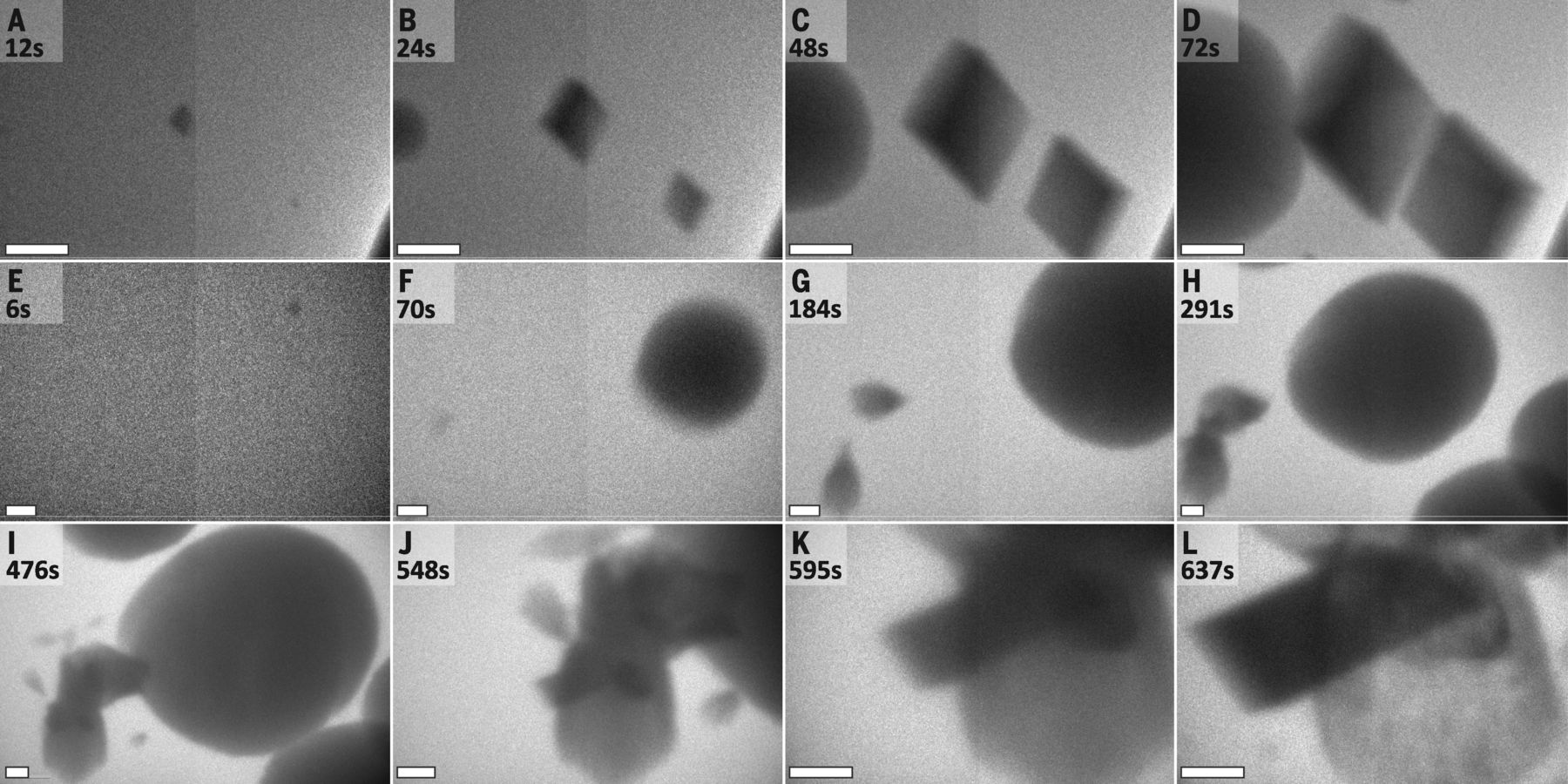
In a study published recently in Science, researchers at Lawrence Berkeley National Laboratory (LBL), Pacific Northwest National Laboratory (PNNL), the University of California, Berkeley and the University of Washington used Hummingbird Scientific’s dual-flow liquid TEM sample holder to observe calcium carbonate crystal nucleation directly. Their research reveals the presence of multiple simultaneously-operating nucleation pathways and calls into question traditional assumptions about the nature of the nucleation process. “For a decade, we’ve been studying the formation pathways of carbonates using high-powered microscopes,” explains Dr. Jim DeYoreo, the project lead, in a PNNL press release. “But we hadn’t had the tools to watch the crystals form in real time. Now we know the pathways are far more complicated than envisioned in the models established in the twentieth century.”
Because calcium carbonate is the largest global carbon sink, the results of this study have particular relevance to climatologists, who could use them to help explain the processes through which carbon dioxide is stored in rocks, minerals, shells, and reefs instead of being released into the atmosphere. In future work, Dr. DeYoreo and his fellow researchers hope to observe living organisms’ roles in calcium carbonate nucleation.
Learn more about the Dual-Flow Mixing Sample Holder used in the experiment
M.H. Nielsen, S. Aloni, J.J. De Yoreo. “In-situ TEM imaging of CaCO3 nucleation reveals coexistence of direct and indirect pathways,” Science 345:6201 (2014) pp. 1158–1162

.png)