.png)

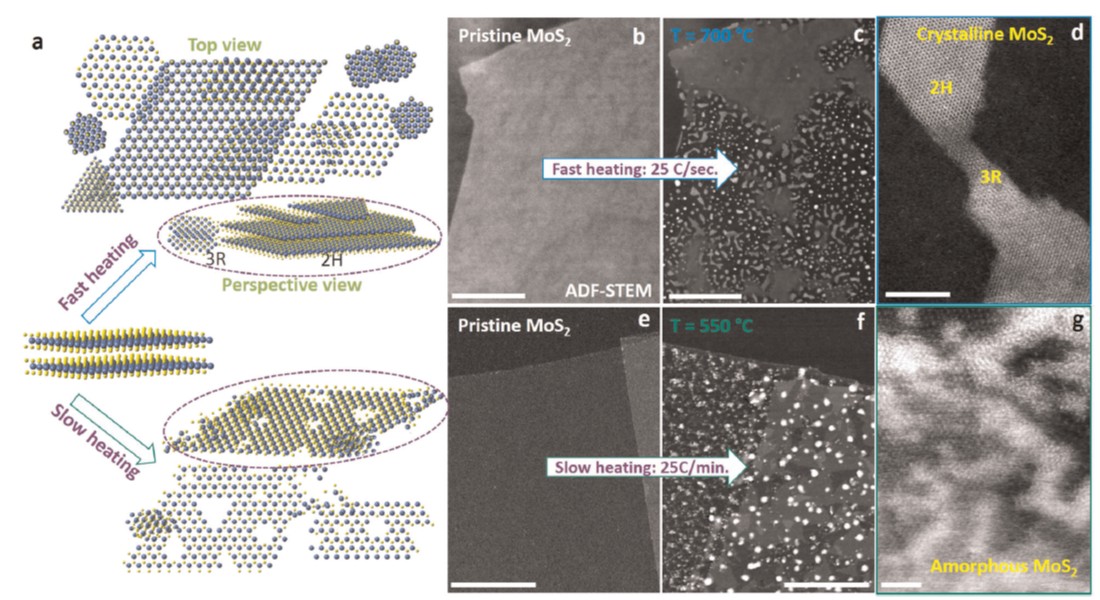
Researchers in the Jariwala, Stach, and Shenoy research groups at the University of Pennsylvania studied, for the first time, direct visualization of structural transformations in MoS2 2D materials at elevated temperatures. They used a Hummingbird Scientific in-situ TEM MEMS heating holder to visualize these transformations at the atomic scale using aberration-corrected scanning transmission electron microscopy.
They report a strong correlation between the resulting structures after using different heating rates in their in-situ heating experiments. Specifically, fast heating rates resulted in a highly ordered, sub-10 nm size crystalline islands that are composed of both 2H and 3R phases. On the other hand, slow heating rates resulted in nanocrystalline and amorphous regions. They explain the different phases observed using different heating rates by differences in the rate of evaporation and redeposition of sulfur from the 2D MoS2 flakes.
These insights are important as they can lead to the development of new methods to synthesize 2D layered nanostructures with unique electronic or optical properties. Read more about their work in npj 2D Materials and Applications.