.png)

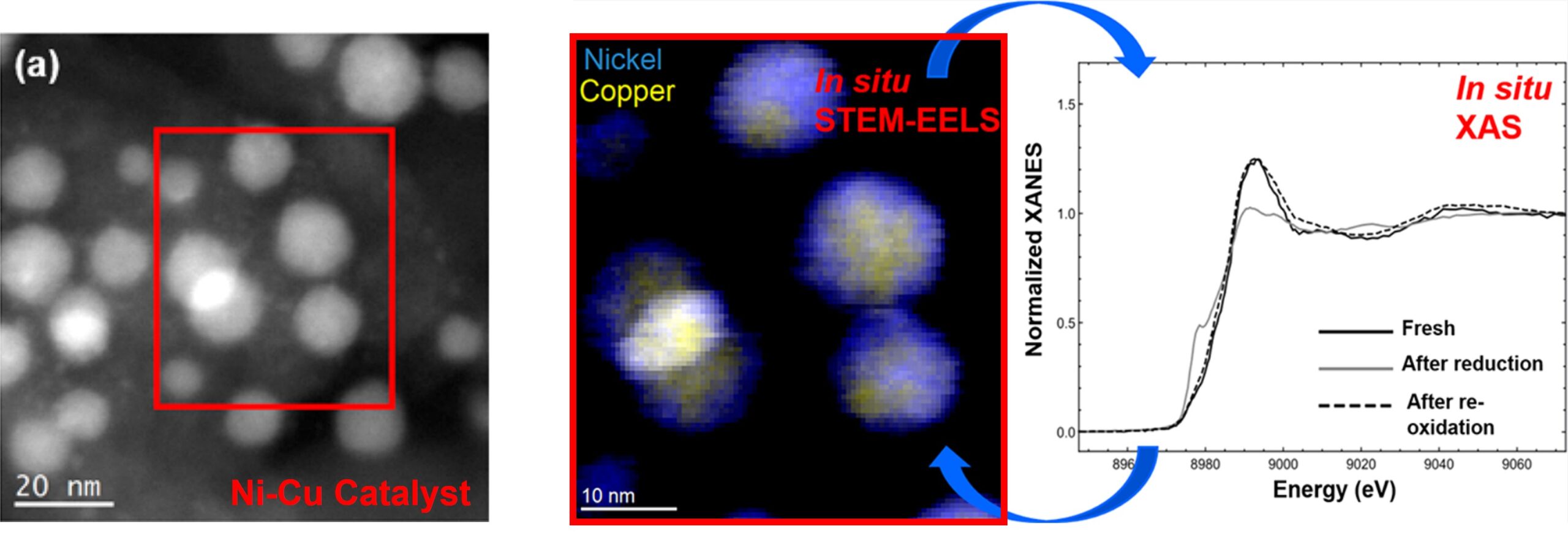
Researchers from the University of Pennsylvania, Stony Brook University, Harvard University, and Brookhaven National Laboratory conducted an in situ TEM experiments using Hummingbird Scientific’s in-situ TEM Gas heating holder system to characterize NiCu₃ nanoparticles with in situ scanning transmission electron microscopy and electron energy-loss spectroscopy (STEM-EELS). They then ran the same experiments using in situ X-ray absorption spectroscopy (XAS) and overlaid the results. From those experiments they mapped the dynamical restructuring effects at the atomic scale of these catalysts during in-situ oxidation and reduction.
With Improved high resolution and accuracy EDS mapping with less background at the highest temperatures, Hummingbird Scientific’s in-situ TEM Gas Heating holder also minimizes drift to the point that one can collect data without drift-correction. The work presented here using the Gas Heating Cell TEM/X-Ray sample holder shows a unique method to perform controlled monitoring of high-temperature oxidation/reduction processes at ambient conditions across multiple microscope platforms that combine imaging with chemical analysis.