.png)

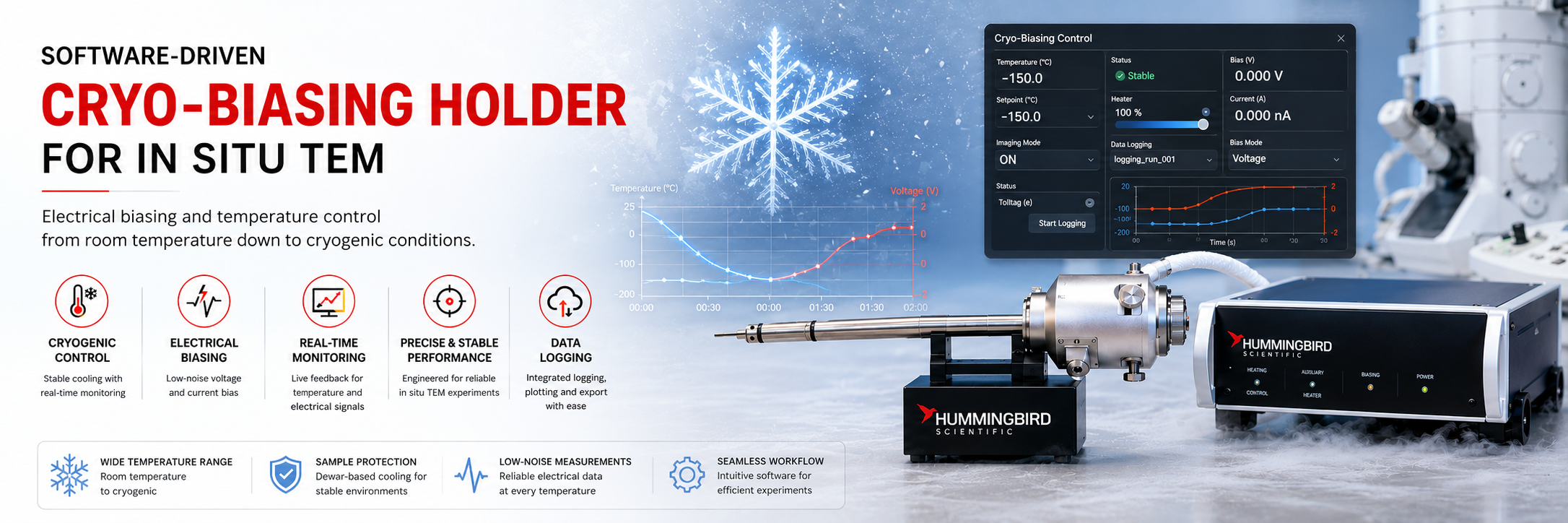
Hummingbird Scientific’s Cryo-Biasing Control Software enables precise temperature and electrical control during in situ electron microscopy experiments at cryogenic conditions.
The software allows users to cool samples to cryogenic temperatures and maintain stable conditions while monitoring system behavior in real time. In addition to temperature control, the platform supports electrical biasing and measurement, enabling combined thermal and electrical experiments.
Designed for cryo-biasing TEM holders, the system supports experiments that require low-temperature environments, such as studies of temperature-dependent behavior, phase changes, and material stability.
By combining cryogenic temperature control with electrical measurement capabilities, the software provides a flexible platform for advanced in situ microscopy research.

Hummingbird Scientific’s cryo control software is designed specifically for in situ microscopy, delivering stable performance at extreme temperatures.
The software is tightly integrated with Hummingbird cryogenic holders and controllers, ensuring accurate temperature regulation and reliable system operation. Built-in control modes allow users to maintain stable conditions or adjust temperatures as needed, while real-time monitoring provides visibility into system performance.
With the ability to combine cryogenic temperature control and electrical biasing in a single interface, the software enables complex experiments without requiring multiple control systems.

The software provides precise control over sample temperature at cryogenic conditions, allowing users to set and maintain target temperatures.
Users can define temperature setpoints and adjust conditions in real time. The system automatically regulates heating to maintain stability, ensuring consistent low-temperature operation during experiments.
In addition to temperature control, the software supports electrical biasing, allowing users to apply and measure voltage during experiments. These combined controls enable coordinated thermal and electrical workflows.
The software supports flexible operation modes to accommodate different experimental needs.
Users can maintain stable cryogenic temperatures using closed-loop control or adjust conditions dynamically as experiments progress. An imaging mode allows the system to temporarily stabilize conditions during data collection, reducing fluctuations.
These modes support both steady-state experiments and workflows that require controlled changes in temperature or electrical input.
The software supports cryogenic operation through integration with liquid nitrogen cooling systems, enabling extended low-temperature experiments.
Once cooled, the system maintains stable temperatures while minimizing drift caused by thermal contraction. This allows users to perform imaging and measurements under consistent cryogenic conditions.
The ability to sustain low temperatures over extended periods supports experiments that require long acquisition times or stable environmental conditions.
The software continuously monitors temperature and electrical signals, providing real-time feedback during experiments.
Users can observe temperature behavior and system response through live plots, enabling immediate insight into stability and transitions. Electrical measurements, including voltage and current, are also displayed in real time.
This combined visualization allows users to monitor both thermal and electrical conditions simultaneously.
The software is designed to work directly with Hummingbird Scientific cryo-biasing holders and controllers.
This integration ensures reliable communication, accurate temperature regulation, and stable electrical measurement. The system provides feedback on operating conditions, allowing users to confidently manage both thermal and electrical parameters during experiments.
Because the software and hardware are designed together, setup is streamlined and experiments can be performed with minimal configuration.

The software records both temperature and electrical measurement data during experiments, providing a complete dataset of system behavior under cryogenic conditions.
The system records temperature as a function of time, along with electrical data such as current and voltage during biasing experiments.
Both temperature and electrical signals are displayed in real time through live plots, allowing users to monitor system stability and response.
Data can be exported in CSV format for analysis in external tools, and graphs can be saved for reporting and documentation.
Users can manage experimental data within sessions, enabling multiple tests and comparisons under different temperature and biasing conditions.