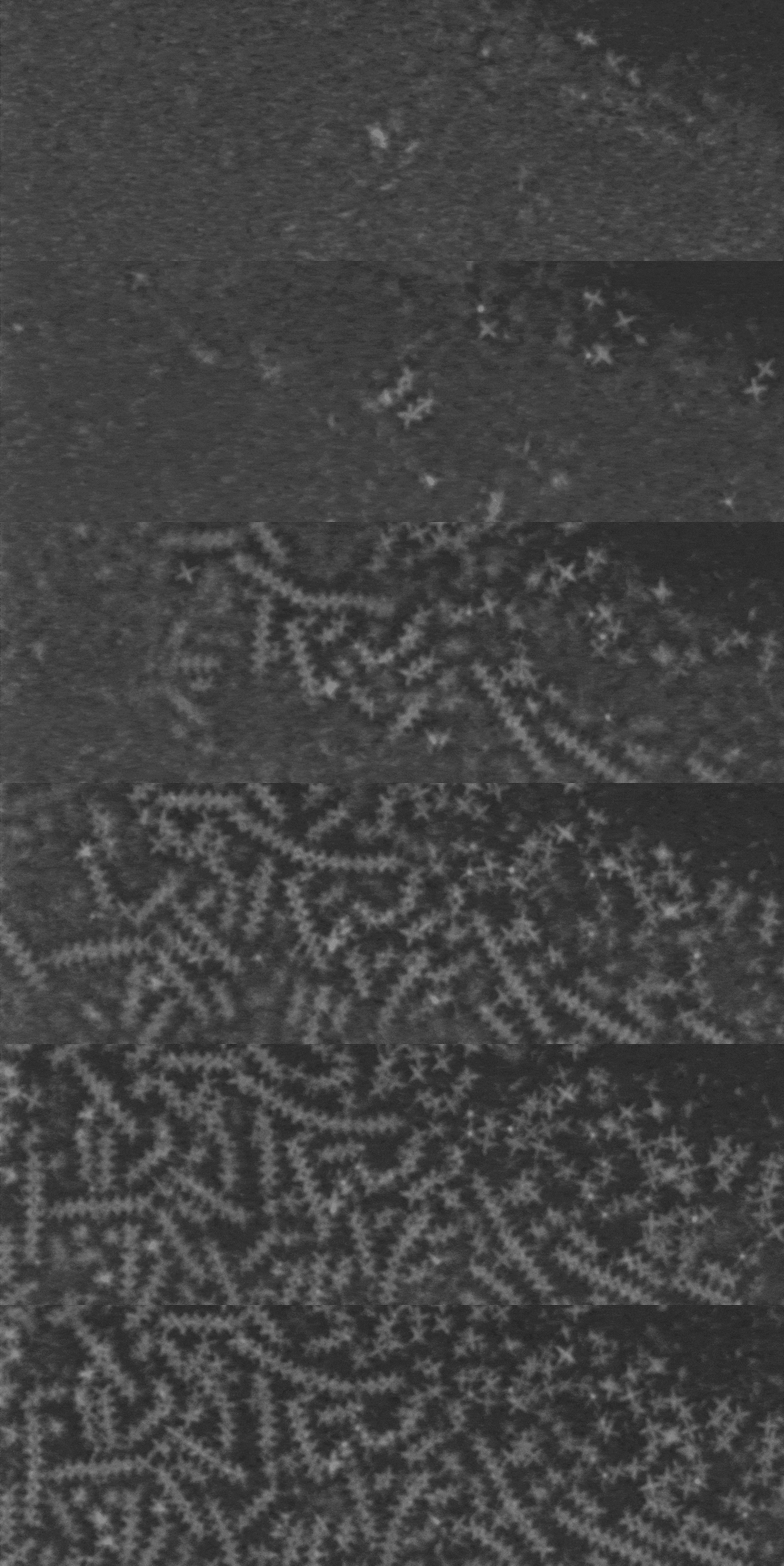
How does in-situ characterization change our understanding of nucleation and growth mechanisms?

Hummingbird Scientific in-situ sample holders enable real-time, atomic-resolution characterization of nanomaterials nucleation and growth processes, directly linking formation pathways to final structure, morphology, and functional properties. Perform multi-modal TEM, SEM, and X-ray experiments across gas, liquid, and vacuum environments, with closed-loop temperature control to over 1000 °C to capture nucleation, phase transformations, and reaction kinetics. Every Hummingbird holder is developed for performance, reproducibility, and ease of use. Scroll down to explore the types of synthesis experiments made possible by these holders.

Why Hummingbird Scientific for

Synthesis

research? 

Studying catalytic mechanisms requires understanding how materials behave during reactions, where structure, chemistry, and performance continuously evolve. These processes must be observed under realistic reaction environments, while conventional electron microscopy is often limited to pre- or post-reaction analysis, making it difficult to capture these dynamic processes.


In-situ and operando TEM enable direct observation under working conditions. Hummingbird Scientific extends this capability with stable imaging across gas, liquid, and electrochemical environments, and experiments at up to 2 bar and above 1000 °C, allowing catalysts to be studied under realistic conditions with high reproducibility.

Real-time catalyst behavior during reactions

Observe catalyst restructuring, degradation, and active-site evolution during reactions under operando conditions, overcoming the limitations of post-reaction analysis and enabling direct identification of activity and deactivation mechanisms.

Structure–performance relationships in real time

Correlate nanoscale structure with catalytic activity and selectivity during reactions, linking morphology, composition, and oxidation state directly to performance, which are otherwise difficult to resolve without real-time observation.

Realistic reaction conditions at high temperature and controlled pressures

Study catalysts under controlled gas and liquid environments at elevated temperatures with stable imaging performance, ensuring behavior can be observed under realistic conditions rather than approximated.

  • Temperatures above 1000 °C with minimal drift
  • Controlled gas and liquid environments
  • Stable imaging without drift correction

Catalyst restructuring and phase transformations

Capture dynamic structural and chemical changes during reactions, including restructuring, phase transformations, and active-site evolution, which are often not accessible through static or ex-situ analysis.

Biomineralization Processes

Under continuous liquid flow and/or mixing

Read More

Dissolution-renucleation processes

In-situ liquid phase imaging

Read More

Growth and Shape Evolution of Nanocrystals

In controlled in-situ liquid environments

Read More

Gas Phase Growth of Nanomaterials

In-situ at temperatures >1000 ºC

Read More

Nanoparticle self-assembly processes

Track particle lattice growth in real time

Read More

Growth of Metal-Organic Frameworks (MOFs)

From nucleation to complete synthesis

Read More

Electrochemical Growth

Controlled biasing in liquids

Read More

Temperature Dependent Crystal Growth

Liquid phase heating over 300 ºC

Read More

Low dimensional materials synthesis

Vacuum heating >1000 ºC

Read More

Which type of experiment best matches your research?

The right experimental setup depends on the question you need to answer. Use the guide below to find published examples, experimental possibilities, and the holder solutions to support them.

Biomineralization Processes

Under continuous liquid flow and/or mixing

Read More

Dissolution-renucleation processes

In-situ liquid phase imaging

Read More

Growth and Shape Evolution of Nanocrystals

In controlled in-situ liquid environments

Read More

Gas Phase Growth of Nanomaterials

In-situ at temperatures >1000 ºC

Read More

Nanoparticle self-assembly processes

Track particle lattice growth in real time

Read More

Growth of Metal-Organic Frameworks (MOFs)

From nucleation to complete synthesis

Read More

Electrochemical Growth

Controlled biasing in liquids

Read More

Temperature Dependent Crystal Growth

Liquid phase heating over 300 ºC

Read More

Low dimensional materials synthesis

Vacuum heating >1000 ºC

Read More

Low dimensional materials synthesis

Vacuum heating >1000 ºC

Products and Research

Temperature Dependent Crystal Growth

Liquid phase heating over 300 ºC

Products and Research

Electrochemical Growth

Controlled biasing in liquids

Products and Research

Growth of Metal-Organic Frameworks (MOFs)

From nucleation to complete synthesis

Products and Research

Nanoparticle self-assembly processes

Track particle lattice growth in real time

Products and Research

Gas Phase Growth of Nanomaterials

In-situ at temperatures >1000 ºC

Products and Research

Growth and Shape Evolution of Nanocrystals

In controlled in-situ liquid environments

Products and Research

Dissolution-renucleation processes

In-situ liquid phase imaging

Products and Research

Biomineralization Processes

Under continuous liquid flow and/or mixing

Products and Research

Browse More Publications

See More Publications
Thank you! Your submission has been received!
Oops! Something went wrong while submitting the form.

Video Spotlight

Observing nanoparticle self-assembly under liquid environment

Understanding how mechanical properties emerge at the nanoscale is key to advancing programmable materials. In self-assembled nanoparticle systems, lattice geometry and interparticle interactions give rise to topological mechanics linking deformation, floppy modes, and phonon-like dynamics. In liquid environments, thermally driven fluctuations enable reconfigurable lattices and measurable nanoscale mechanical responses. The Hummingbird Scientific liquid flow sample holder enables stable, real-time imaging of these processes in solution, providing the environmental control and resolution required to track particle motion, visualize lattice evolution, and quantify emergent mechanical behavior in situ.

The video shows the real-time self-assembly of a rhombic Maxwell lattice from colloidal gold nanocubes, captured using in-situ liquid-phase TEM. Individual particles were tracked with high spatial and temporal resolution, with centroid positions (yellow) and the reconstructed bond network overlaid to reveal how local interactions drive long-range order. Subtle lattice distortions, including rhombus tilting, highlight the system’s dynamic mechanical behavior. Scale bars: 300 nm.

Hummingbird Advantages

  • Sealed, electron-transparent liquid cell allows imaging under continuous liquid flow.
  • Mechanically stable holder design enables nearly drift-free imaging allowing accurate particle tracking.

Reference: Chang Qian, et al, Nat. Mater. 24, 1616–1625 (2025). DOI: 10.1038/s41563-025-02253-3

Movie copyright © 2025 Springer Nature Limited

Compare Tool Capabilities

Choose a specimen holder based on your experimental and compatibilty needs
    TEM Nano-ManipulatorHeating- BiasingTEM TomographyBulk Liquid ElectrochemistryCryo Biasing TEM
Microscope/ TechniqueTEM version available
Microscope/ Technique
TEM Version Available
Excellent
Excellent
Excellent
Excellent
Excellent
 SEM version available
N/A
Excellent
N/A
Excellent
N/A
 X-Ray version available
N/A
Excellent
N/A
Excellent
N/A
Battery ConfigurationIndividual nanowire/nanoparticle
Excellent
Excellent
Excellent
Excellent
Excellent
 Thin film
Good
Excellent
Excellent
Good
Excellent
StimuliElectrical
Excellent
Excellent
N/A
Excellent
Excellent
 Thermal
N/A
Excellent
N/A
Excellent
Excellent
 Optical TEM version available
Good
N/A
N/A
Excellent
N/A
ImagingHigher resolution and diffraction
Excellent
Excellent
Excellent
Good
Excellent
 EDS/EELS compatibility
Excellent
Excellent
Excellent
Good
Excellent
 3D reconstruction
Good
Good
Excellent
N/A
N/A
 In-situ imaging
Excellent
Excellent
Excellent
Excellent
Excellent
 Pre-and post-mortem analysis
Good
Good
Excellent
Good
Good
 Transfer air-sensitive samples
Good
Good
Good
Excellent
N/A
Beam EffectsCompatibility with volatile electrolytes
N/A
N/A
N/A
Excellent
N/A
 Minimal beam damage
Good
Good
Good
Good
Good
Quantitative ElectrochemistryReplicate bulk measurements
Good
N/A
Excellent
Good
Good
 Image all battery components
Good
Excellent
N/A
Excellent
Excellent
 Longer cycling
Excellent
Excellent
N/A
Excellent
Excellent
TEM Nano-Manipulator
Excellent
N.A.
N.A.
Excellent
Good
Excellent
N.A.
Good
Excellent
Excellent
Good
Excellent
Good
Good
N.A.
Good
Good
Good
Excellent
TEM Tomography
Excellent
N.A.
N.A.
Excellent
Excellent
N.A.
N.A.
N.A.
Excellent
Excellent
Excellent
N.A.
Excellent
Good
N.A.
Good
N.A.
N.A.
N.A.
N.A.
N.A.
Excellent
Heating-Biasing
Excellent
Excellent
Excellent
Excellent
Excellent
Excellent
Excellent
N.A.
Excellent
Excellent
Good
Excellent
Good
Good
N.A.
Good
Excellent
Excellent
Excellent
N.A.
N.A.
Excellent
Gas-Heating
Excellent
Excellent
Excellent
Excellent
Excellent
Excellent
Excellent
Excellent
N.A.
Excellent
Good
N.A.
Excellent
Good
Bulk Liquid Electrochemistry features for Tool selector
Excellent
Excellent
Excellent
Excellent
Good
Excellent
Excellent
Excellent
Good
Good
N.A.
Excellent
Good
Excellent
Excellent
Good
Good
Excellent
Excellent
Excellent
N.A.
N.A.
Excellent
Good
N.A.
Product
Stimuli
Key Capability
Use Case
-
Heating
-
Electrical Biasing
>1000 °C, minimal drift
Gas Catalysis
-
Heating
>1000 °C, minimal drift
Gas Catalysis
-
Heating
-
Electrical Biasing
>1000 °C, minimal drift
Gas Catalysis
-
Electrical Biasing
-
Heating
>1000 °C, minimal drift
Gas Catalysis
-
Plasma
>1000 °C, minimal drift
Gas Catalysis
-
Heating
>1000 °C, minimal drift
Gas Catalysis
-
Optical Illumination
-
Heating
>1000 °C, minimal drift
Gas Catalysis
-
Tomography
>1000 °C, minimal drift
Gas Catalysis
-
Air-Free Transfer
-
Electrical Biasing
-
Heating
>1000 °C, minimal drift
Gas Catalysis
Product
Stimuli
Key Capability
Use Case
-
Heating
-
Electrical Biasing
>1000 °C, minimal drift
Gas Catalysis
-
Heating
>1000 °C, minimal drift
Gas Catalysis
-
Heating
-
Electrical Biasing
>1000 °C, minimal drift
Gas Catalysis
-
Electrical Biasing
-
Heating
>1000 °C, minimal drift
Gas Catalysis
-
Heating
>1000 °C, minimal drift
Gas Catalysis
Product
Stimuli
Key Capability
Use Case
-
Heating
-
Electrical Biasing
>1000 °C, minimal drift
Gas Catalysis
-
Heating
-
Electrical Biasing
>1000 °C, minimal drift
Gas Catalysis
-
Heating
>1000 °C, minimal drift
Gas Catalysis
-
Electrical Biasing
-
Heating
>1000 °C, minimal drift
Gas Catalysis
-
Heating
>1000 °C, minimal drift
Gas Catalysis

Compare Tool Capabilities

Choose a specimen holder based on your experimental and compatibilty needs

TEM Product Guide for

Synthesis

Experiments

Product
Stimuli
Key Capability
Use Case
-
Heating
-
Electrical Biasing
Continuous liquid flow
Reactions in flowing liquids
-
Heating
>1000 °C with stable imaging
Gas-phase reactions
-
Heating
-
Electrical Biasing
-
Electrical Biasing
-
Heating
In-liquid electrochemical control
Electrochemical reactions in liquids
-
Plasma
Plasma activation during imaging
Plasma-driven reactions
-
Heating
Up to 30 bar, high-temperature operation
High-pressure gas reactions
-
Optical Illumination
-
Heating
Optical + thermal stimulation
Photo-activated gas reactions
-
Tomography
Pristine and post-mortem characterization
-
Air-Free Transfer
-
Electrical Biasing
-
Heating
Exposure-free sample transfer
Air-sensitive materials

SEM Product Guide for

Synthesis

Experiments

Product
Stimuli
Key Capability
Use Case
-
Heating
-
Electrical Biasing
>1000 °C, minimal drift
Gas Catalysis
-
Heating
>1000 °C, minimal drift
Gas Catalysis
-
Heating
-
Electrical Biasing
>1000 °C, minimal drift
Gas Catalysis
-
Electrical Biasing
-
Heating
>1000 °C, minimal drift
Gas Catalysis
-
Heating
>1000 °C, minimal drift
Gas Catalysis

X-ray Product Guide for

Synthesis

Experiments

Product
Stimuli
Key Capability
Use Case
-
Heating
-
Electrical Biasing
>1000 °C, minimal drift
Gas Catalysis
-
Heating
-
Electrical Biasing
>1000 °C, minimal drift
Gas Catalysis
-
Heating
>1000 °C, minimal drift
Gas Catalysis
-
Electrical Biasing
-
Heating
>1000 °C, minimal drift
Gas Catalysis
-
Heating
>1000 °C, minimal drift
Gas Catalysis

Frequently Asked Questions

What is in-situ TEM in catalysis?
What is the difference between in-situ and operando TEM?
How do you study catalysts at high temperature in TEM?
Why is real-time observation important in catalysis?

Ready to discuss your experiment?

Our applications scientists can help identify the right products, experimental workflows, and published examples for your research.